Friday, March 7, 2014

Sleight of Hand, part 2

Clean water and healthy waterways lose again in Maryland....Lower Shore Senators have introduced a number of bills this 2014 session in an effort to continue the delay of the Phosphorus Management Tool implementation.  Now it seems Senator Mathias and others have found the democratic process for implementing the Phosphorus Management Tool (PMT) regulations just a little too tedious, and so have decided to run around the 'democratic' part of the process where the public has an opportunity to voice support or objections.  Instead, they are going to bypass both the legislative and regulatory processes by inserting amendments into the budget that not only will place new requirements on the development of this tool and further delay an important regulation that will help clean up the Chesapeake Bay and protect our Coastal Bays, but could set a dangerous precedent for all manner of regulatory legislation in the future.  And our Governor remains strangely quiet this week despite his earlier promises to see the PMT implemented in a timely manner. 

Today the Maryland Clean Agriculture Coalition released the following statement:

FOR IMMEDIATE RELEASE
March 7, 2014
Contact: Dawn Stoltzfus, The Hatcher Group, 410 990 0284, 410 562 5655 (cell)

ENVIRONMENTAL ORGANIZATIONS OPPOSE UNPRECEDENTED SENATE BUDGET AMENDMENT TO DELAY PHOSPHORUS REGULATIONS
Groups say the amendment is bad policy and unnecessary

(Annapolis, MD) -- Environmental organizations are opposing a proposed amendment to the state’s budget that would prohibit the Maryland Department of Agriculture from continuing to develop regulations to reduce phosphorus pollution until the completion of an expansive economic study.
Advocates say passage of the amendment would set a dangerous precedent not only for this specific matter, but also for other future regulatory actions. The Senate Budget and Taxation Committee is set to vote on the proposed budget amendment this afternoon.

Governor O’Malley has committed to implementing the science-based Phosphorus Management Tool, which will reduce pollution by limiting the use of manure applied to farm fields oversaturated with phosphorus. The Administration has also already committed to conducting an additional economic study, making the amendment unnecessary. The study begins this upcoming Monday.
“Opponents to the phosphorus management tool are attempting to bypass both the legislative and regulatory processes by inserting into the budget new requirements on the development of this tool, ” said Joanna Diamond of Environment Maryland. “This undercuts the transparent, participatory way in which both bills and regulations are supposed to be adopted in our state.”

“This amendment sets a dangerous precedent,” said Karla Raettig of the Maryland League of Conservation Voters. “Not only would it constrain funding for regulations essential to restoring the health of the Chesapeake and local waters, it could threaten other future regulations, whether they are for hospital safety or teacher certification or handicapped access or any new effort to protect human health, public safety, or our natural environment.”

“This amendment is political posturing at its worst,” said Betsy Nicholas of Waterkeepers Chesapeake. “Not only is it harmful, it’s entirely unnecessary.”

The Phosphorus Management Tool would replace the Phosphorus Site Index (PSI). University of Maryland scientists have firmly established that the PSI, an existing tool in use since 2001, is fundamentally flawed due to outdated science. The PSI tool allows for a far greater risk of farm field phosphorus polluting Maryland waters than previously believed.

The Phosphorus Management Tool (PMT) regulations have been repeatedly delayed due to objections
from agricultural industry lobbyists and pressures from legislative leaders. They are already four years late. Maryland’s 2010 Chesapeake Bay Watershed Implementation Plan (WIP) committed the state to updating the Phosphorus Management Tool in 2011.

In November, the O’Malley/Brown Administration withdrew its proposed PMT regulations for the
second time in four months but committed to implementing them before the end of O’Malley’s term.

The economic study is not the only concern that the Administration has accommodated in response to
opposition to the PMT. The Administration has already agreed to:
  • • delay implementation for a year by conducting additional in-field testing of the PMT;
  • • phase-in the PMT over at least a three-year period; and
  • • provide additional funding for impacts arising out of PMT implementation (e.g., tweak the manure transport program to provide greater ease of access by farmers with excess manure).
                                                                          ###
Assateague Coastal Trust – Audubon Naturalist Society – Chesapeake Climate Action Network – Environment Maryland – Environmental Integrity Project –Gunpowder Riverkeeper – League of Women Voters of Maryland –Maryland League of Conservation Voters – National Wildlife Federation Mid Atlantic Regional Center – Severn Riverkeeper – Sierra Club, Maryland Chapter – Stewards of the Lower Susquehanna, Inc. – Waterkeepers Chesapeake – West Rhode Riverkeeper

The Maryland Clean Agriculture Coalition is working to improve Maryland waterways and protect public health by reducing pollution, and increasing transparency and accountability, from agriculture and other associated sources of water degradation.

Monday, February 10, 2014

Sleight Of Hand Trick

It can’t be easy fighting off government’s attempt at implementing environmental regulations with one hand while grabbing fist loads of government cash with the other hand.


One of the most hotly debated set of bills this current Maryland legislative session are the ones being introduced by several Eastern Shore legislators all attempting to delay the implementation of a new tool being proposed to address the over-application of manure on farms in the state. The Phosphorus Management Tool (PMT) was developed as a replacement for the current phosphorus application standard that hasn’t worked to keep excess phosphorus from pouring off farms fields and into the Bay. 

Much of this problem in Maryland is caused by the massive amounts of chicken manure produced by the three big chicken companies who operate in the state, but who refuse to take any responsibility for the waste from their production systems. According to some recent estimates, agricultural operations account for 64% of the phosphorus entering the Chesapeake Bay, contributing significantly to the summer dead zones every year.

The plan to update the state’s phosphorus application standards has met with all the typical ag industry-generated doomsday predictions that greet every attempt to get the industry, the largest nutrient and sediment polluters of our waterways, to clean up their operations. Last fall’s efforts to implement the PMT were met with threats of busloads of farmers descending on Annapolis in protest. These threats resulted in agribusiness, the administration and the environmental community striking a deal to implement the PMT over the coming 2 years, a deal that industry promptly reneged on as soon as they left the meeting and arrived back down on the Eastern Shore. 

Now, the Eastern Shore ag industry has sent their delegates to Annapolis to demand that before the PMT gets implemented there must be a study of its economic impact on farmers who will no longer be allowed to dump manure on fields to wash into the Bay and the rest of Maryland’s waterways.  Interestingly, these same elected officials have chosen not to balance that study with another, of the economic impacts from phosphorus polluted waterways, fish kills, dead zones, and a failed tourism economy on the Eastern Shore.

Last week, the ag industry dispatched Kevin Anderson, president of the Maryland Grain Producers Association and a Somerset County farmer, to testify before the House Environmental Matters committee. He stated, without any support, that compliance with the protective standards of the PMT would cost him about $150,000. He also did the math and claimed that the 20 farms in Somerset County would be out $3 million if they could no longer dump manure on their phosphorus-saturated fields.

Anderson’s testimony was meant to impress on the Committee the tremendous “economic tsunami” that the government was going to create for him and his fellow farmers should the PMT be implemented to protect the Chesapeake Bay. What he didn’t testify to, though, was the even more impressive economic subsidies he’s received from the government to run his farm. It can’t be easy fighting off the government’s attempt to implement environmental regulations with one hand while grabbing fist loads of government cash with your other hand.

According to the Environmental Working Group’s online database of subsidies to the ag industry, Anderson’s Wimberly Farms received $977,753 in taxpayer-funding from 2000 to 2012. And his fellow Somerset County farmers aren’t doing too badly either when it comes to government subsidies. From 1995 to 2012 Somerset County farms have received $17,641,357 in payments. In fact, since 1995 the federal government has pumped over $1 billion dollars of taxpayer money into Maryland agribusiness. Add to that the tens of millions of dollars in state funding that is handed to the industry annually for cover crops, storage sheds and manure transport programs to help control its waste, and Anderson got it right - we really are talking about an economic tsunami, but one which carries green waves of money to Maryland farms. 

Farm subsidies are an important part of our country’s food system; America’s farmers deserve financial help to grow the food we all rely on. Struggling farmers, like anyone else struggling to survive in the United States, need a helping hand. But there’s more than a bit of hypocrisy involved when people complain about government interference in their affairs when our federal and state agencies try to implement protective environmental standards, yet sit quietly as government “interferes” with their bank account with hundreds of thousands of dollars in corn, soy and wheat subsidies.

Government-provided farm subsidies can be good for everyone when managed and implemented properly. Likewise, government-provided environmental regulations are beneficial to the nation as a whole, especially when they’re being implemented to help save a national treasure like the Chesapeake Bay from extinction. When Mr. Anderson returns the almost $1 million taxpayer dollars he’s received in financial support from the government, maybe then he can complain about the economic burden of protective environmental standards like the PMT. Until then, he and all the ag industry – the most heavily subsidized industry in the country - should be thankful for the significant governmental support that sustains their operations and be the first to stand up for good, sound environmental practices like the PMT.


Tuesday, October 29, 2013

Intersex Fish Are Not Sexy!


Did you know that sewage treatment plants can not filter out all pharmaceuticals, and discharge hormones, antibiotics and other similar substances into our waterways?  Not a pleasant thought about what goes into the very water we swim in, fish in, or in some watersheds actually drink from!

Until recently, consumers have been told to flush unwanted drugs. With technological advances and research, low levels of drugs are being found in our surface waters. Recent research by the U.S. Geological Survey now confirms that some drugs pass largely unaltered through our sewage treatment plants and enter our Bays and other waters.

Recent research has also shown that continuous exposure to low levels of medications has altered the behavior and physiology of fish and aquatic life. Male fish and crabs are being found with eggs or female organs, most likely caused by long term exposure to hormones and other endocrine disruptors. This phenomena is called 'intersex' and is becoming more common in rivers like the Potomac with its large urban sewage treatment plants, but intersex fish have also been found in Delaware ponds and lakes on the Delmarva Peninsula.

The preferred method for disposal of unused medications is incineration. While we obviously can't stop the introduction of some pharmaceuticals into our wastewater because of normal bodily functions, we CAN control what happens to medications that are not consumed!


That is why the Assateague Coastal Trust and it's COASTKEEPER program advocate for the safe disposal of unused and expired medications.  Our motto is:  "Don't Flush!  Hold It!" Dispose of them properly so our fish don't become confused about their sexuality.

In partnership with the Worcester County Sheriffs Department, Worcester County Health Dept and the Police Departments of Berlin and Ocean City, ACT co-hosted the 3rd Annual Fall Operation Medicine Drop event on Saturday, Oct 26, 2013.  While the daily total of medications turned in on Saturday was below average, everyone agrees this is the result of the two new permanent drop boxes in Ocean City and Ocean Pines actively being used by local citizens all year around.

As of July 2013, over 460 pounds of unused or expired medications had been turned in through the permanent drop boxes and during the spring 2013 Operation Medicine Drop event.   We fully expect by the end of 2013 Worcester County will have far exceeded the 524 pounds of medications collected in 2012.   This is a huge victory for clean, ‘fishable,’ waterways in the Coastal Bays watershed!  

#swimdrinkfish 

Permanent Drop Boxes in Worcester County, MD are located at:
     Ocean City Police Department, 65th St. Ocean City
     Ocean Pines Police Department, White Horse Park, Ocean Pines 


Thursday, January 26, 2012

Taking Care of Nature

On January 24 in Annapolis Rabbi Nina Beth Cardin, with the Baltimore Jewish Environmental Network, addressed the 400+ people attending the 2012 Environmental Legislative Summit with the following remarks.  She was sitting to my left and I watched her tweak her notes a few times, but I wasn't aware she was a speaker for the event.   After she spoke, I thanked her for her truly inspiring words.  And now I have the opportunity to share her words with you.  Enjoy, and carry her thoughts with you going forward.


Environment Summit - 2012
Rabbi Nina Beth Cardin
January 24, 2012


We live in the midst of a 4-billion year old mystery, an on-going miracle that we call Earth.  For all we know, no such miracle exists anywhere else.  Whatever we may be skilled enough to find out there, there is likely not to be another Planet Earth, or another you, or another me, or another Bay or the parade of moonrises and sunsets, or the cascade of creatures that have filled our air and seas and land and made our world what it is today.

We are the chosen ones, blessed with being alive at this awesomely rich and perilous time. We didn’t ask for this moment, we didn’t create it, we did not earn it, and we don’t even understand it.

What we do understand, however, is that something very dangerous – even wicked - is happening out there – and we are doing our share to cause it.

But the good news is, we can do our share to stop it.

We are Earth’s most aware beneficiaries and its most powerful stewards.

We are not its masters, we are not its owners. We are its tenders. We are called upon to use it, take care of it, and give it – healthy and robust - to our children, just as our ancestors gave it to us.

Thomas Berry, the Catholic theologian – taught that each generation has a Great Work. It is a work that we do not choose, but that we are dealt by the hand of history. It is a work that drives our ultimate purpose and inspires our days, a work that all future generations will judge us by, a work that is bound to “the larger destinies of the universe.”

Our generation’s Great Work is to learn to thrive within life’s sustaining cycles. Our Great Work is to build a world that is resilient, ever new and ever fresh to each generation, that matches our desires and consumption, our use and our waste, our progress and our joys, to the untransgressible bounds of nature. 

We must do this and we can do this, for we are not alone.

It is crowded in here.

It is crowded with your passion and persistence, your hard work and hopes, your wisdom and commitment.

And it is crowded with the concern and confusion, the hunger and the worry, the needs and prayers of hundreds more, thousands more, millions more who have never heard of you, but who depend upon you, and who need you to pursue this sacred work.

For all of us work on behalf of everyone who takes a breath of air, who wants a sip of clean water, who works to put food on their table, who takes refuge from the cold, seeks a good day’s work today and tomorrow, anyone who relies upon this awesome, giving world for their manifold, mundane needs.  And that is everyone.

The names we use to describe our work might be throwing people off. It seems to me that Senator Carter Conway’s and Delegate McIntosh’s committees might need to be renamed:

Perhaps something like the:  Education, Health and Environment, Economy, Jobs, Energy, Equity, Life’s Well-being, Earth Stewardship and Children of Tomorrow Committees.

The world of tomorrow will not be the world of yesterday. It will take more than science and knowledge, more than money and regulations to get us from here to there. It will take our trust, it will take our will, and it will take our faith.

We are not engaged in an us-vs-them agenda.  It is not about jobs vs the environment; enviros vs progress, government vs the people. 

Our task can be stated simply:

It is about us taking care of nature so nature can take care of us.

There is a great future waiting for us; we must find the way, and we must all get there together.

That is our Great Work.
That is our sacred work.
And that is why you are here.
Thank you!

You can follow her Blog in the Baltimore Jewish Times

Tuesday, January 10, 2012

New Year Resolutions

The Progger is back.   2011 was a lost year for my blogging efforts.  With so much activity on our Clean Water Act citizen lawsuit against Perdue, I was advised to keep a low profile and so I did.

But this is a new year, and as it is the 40th Anniversary of the Clean Water Act!  I am making a 2012 New Year Resolution to keep this blog active and get back to the business of progging about and exposing the good and the bad of my watershed.

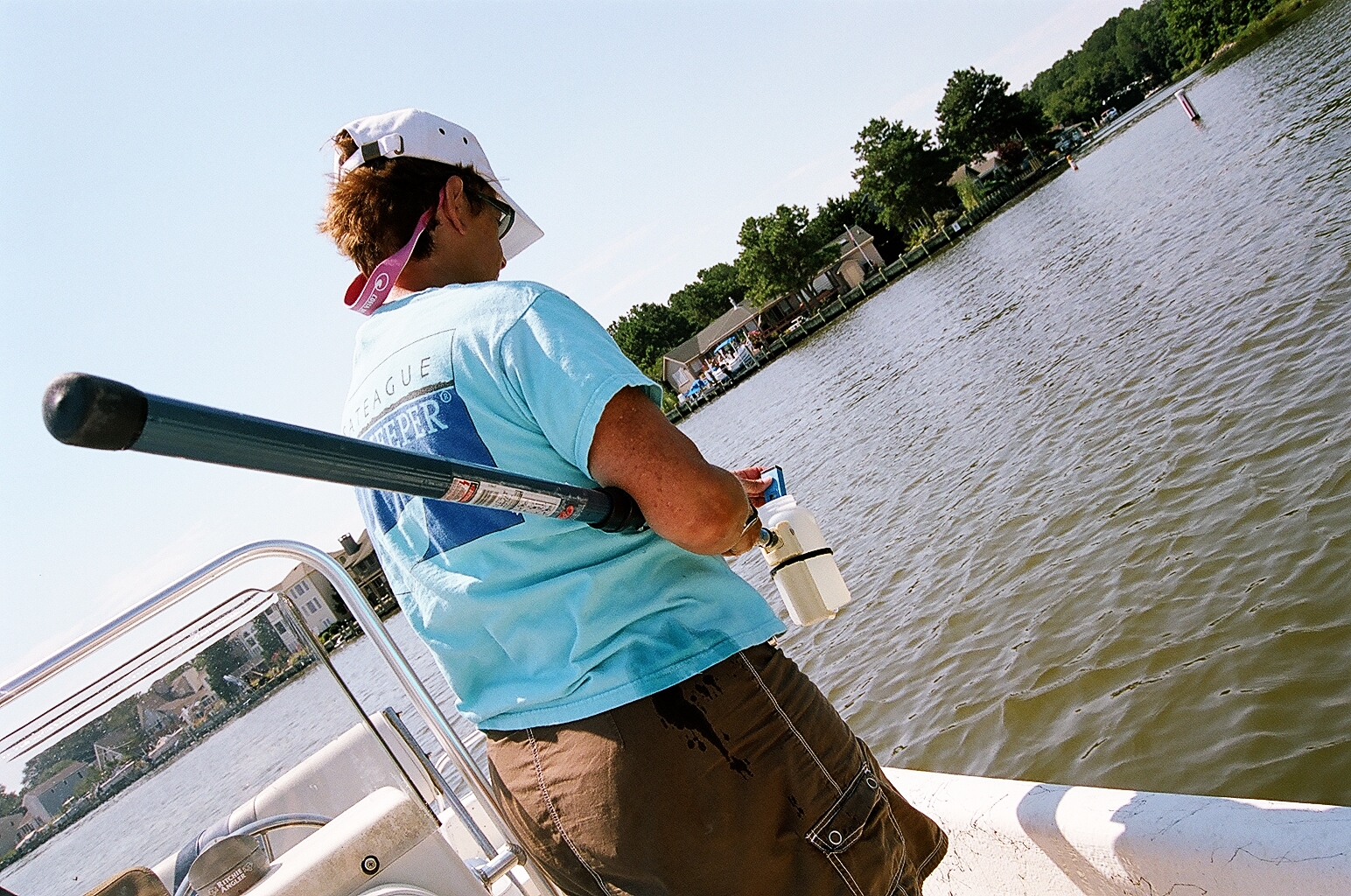
This past fall the Coastkeeper was 'shadowed' for a week by a photo journalism student, resulting in a senior project titled "A Day In The Life Of The Assateague Coastkeeper."  Meaghan Morgan-Puglisi, of Bennington College in Vermont, contacted me last July.  She's a Maryland resident with a love of Assateague Island and the Coastal Bays.  Sitting in my office today, I realize it won't be long until it's time to put the boat back in the water.   Here's a few of her images from last August.


Here's to a new year working towards clean water that is swimmable, fishable and drinkable!  Happy Birthday Clean Water Act.

Watch the new CWA40 Waterkeeper Alliance PSA here!

Wednesday, April 27, 2011

It IS The Economy, Stupid.

The Coastkeeper has been negligent for months and has ignored her blog.  Not the best way to keep my followers following.   Please accept apologies.

The 2011 Maryland General Assembly began it's session shortly after the new year.  I had intended to post updates, news, information about all the exciting environmental bills that were introduced this year, keeping you informed and asking for help with letters/emails/phone calls when needed.

But this year's Session turned into a real slogfest (is that word?) and it was all I could do to take care of matters from my desk and in Annapolis, leaving little time to even try and create a blog posting or two.  Hopefully most of you caught my cries for help on the Coastkeeper Facebook page and I thank all who did write letters, make phone calls or sent emails to their legislators when I asked.

2011 will go down as one of the worst legislative sessions for the environment in history.  Our legislators, who all ran on a 'green' platform promising to clean up the Chesapeake Bay and our other waterways,  caved to industry lobbyists on every important environmental bill.

~Despite all the testimony, facts and an incredibly successful campaign in Washington, DC our lawmakers decided it was ok to keep all those plastic bags flying around our roadsides, forests and in our waterways in Maryland because the plastics industry cried 'foul.'

~Despite peer reviewed studies, facts and analysis presented by scientists and researchers who were experts, but apparantly were NOT highly paid Industry witnesses, our legislators decided it was ok for the chicken produced in Maryland to have arsenic in it when the chemical companies cried 'fowl.'

~And with incredible lack of long term vision, our legislators decided it was ok to burn trash as a 'renewable' resource but offshore wind was going to have to wait.

~State funding to preserve agricultural land was deeply slashed, in a wonderful little bit of budget trickery in which millions of  tax dollars that were paid into a dedicated fund for land preservation were robbed because a loophole allows the State to transfer the money at will into the General Fund in order to 'balance' the budget.

~One bright spot, of sorts, was the passage of a watered down (sorry, pun intended) fertilizer bill that is a good start at reducing phosphorus loads to our waterways.

And while most of the hand wringing and furrowing of eyebrows in the General Assembly these past two months was because all these decisions were made in the 'best interest of the economic situation in Maryland' or because it was feared there would be 'impacts to jobs' in the State, any bill that smacked of regulation was passed down to Committees like a hot potato to be killed by inaction. (Sparing our legislators having to get involved in messy stuff like debate and voting.)

The Economic Policy Institute (EPI) recently published Briefing Paper #305, written by Isaac Shapiro and John Irons, titled: 'Regulation, Employment and the Economy - Fears of job loss are overblown.'

Shapiro and Irons state in the opening Executive Summary of the report,  'In the first months since the new Congress convened, the House has held dozens of hearings designed to elicit criticisms of regulations, introduced legislation that would dramatically alter the regulatory process by requiring congressional approval of all major regulations, and passed a spending bill that would slash the funding levels of regulatory agencies and restrict their ability to enact rules covering areas such as greenhouse gas emissions.'

They further noted, 'In support of each of these steps, opponents of regulation argue that agency rules are damaging to the economy in general and job generation in particular. Some say specific regulations will destroy millions of jobs and cite a study (critiqued later in this paper) purporting to show that regulations cost $1.75 trillion per year. Regulations are frequently discussed only in the context of their threat to job creation, while their role in protecting lives, public health, and the environment is ignored.'

They stated,  'Well-designed and strongly enforced regulations are often necessary for the economy to operate effectively, a proposition supported by the history of regulation.....' and pointed out how lax regulations have resulted in such economic disasters as our recent financial market meltdown, major food poisoning outbreaks, and the mother of all environmental and economic crisis - the BP Deepwater Horizon oil spill.

The report is not very long and very worth the read.

But let's bring this back to Maryland's 2011 Legislative Session.  Taking a lead from their Federal counterparts, environmental regulations or programs at the State level were labeled as a threat to the economy and a job killer.  It has long been a favorite activity in Annapolis to plunder funding sources for the Maryland Department of Environment or attempt to take regulatory oversight away from MDE and place the control in another agency that has no enforcement authority.

So this leads me to a final question - how often do you follow what is happening in Annapolis during the legislative sessions each year?  Do you know who your District Delegates and Senators are?  Do you ever write to them, or call them, or better yet pay a visit to them in Annapolis?   The second most important thing to an elected official is YOUR VOTE (the first most important thing is the industry that contributes the most to their campaigns and the lobbyist representing that industry.)  If your elected officials are hearing from industry lobbyists on a daily basis, who will continue to foster this myth that regulation results in job loss, it just might be a good idea for greater numbers of ordinary citizens to make their voices heard during the sessions.

Our great natural resources-water, forests, wetlands and the air we breath do not have a voice.  They don't have a highly paid lobbyist.  They can't vote.  You must be their voice and speak out,  not only by paying an annual membership to your environmental group of choice or showing up at the polls, but by making your voice heard in person with some face to face time with your elected officials.  Make yourself heard!

Tuesday, December 21, 2010

Season's Greetings - Ask Santa for More Fleece!

Have you missed The Progger?  My apologies, I did indeed fall off the grid this past fall, but hopefully I'll be back on a more regular basis in 2011.

A few things to end out 2010.....first, a greeting card from all of us at Assateague Coastal Trust:


Next - has it been cold enough for you this December?   Well, here are some interesting blog postings from others that I think are worthy of re-posting for your reading pleasure.   Next time you're putting up with someone who pooh-poohs 'global warming' or 'climate change' just pass these along.

FROM MIKE TIDWELL, OF CHESAPEAKE CLIMATE ACTION NETWORK:
All,
See below some helpful blog posts explaining the recent cold weather in North America and Europe in the context of global warming. Turns out, the vanishing Arctic ice is creating a phenomenon similar to a refrigerator door being left open. The cold air is filling up the whole room but the refrigerator itself is being emptied of its vital coldness. The process is utterly unsustainable and leading to disruption and loss for the whole house.
Mike Tidwell
Director, Chesapeake Climate Action Network
------------------------------------------------

From Eric Haxthausen of the Nature Conservancy:
The cold weather we have been experiencing on the East Coast is likely to sow further confusion in the minds of some Americans about whether the Earth is truly warming. I put together the blog post below to highlight some of the recent science about this, and thought it may be of interest. -Eric

http://change.nature.org/2010/12/15/with-all-this-global-warming-why-is-it-so-cold/

Well, this is why we now use the term climate  change
http://www.nature.org/initiatives/climatechange/


Jeff Masters at the Weather Underground has a good post on what is happening with our weather that is making it so cold
http://www.wunderground.com/blog/JeffMasters/comment.html?entrynum=1710&tstamp=&page=1

And  there is a good graphic at NOAA website that explains it.
http://www.arctic.noaa.gov/future/index_impacts.html


The explanation that is gaining currency among climate scientists is that low levels of Arctic sea ice during the summer are causing more heat to be absorbed in the Arctic during the fall, and changing atmospheric circulation patterns, driving cold Arctic air into Europe and the Eastern United States and funneling warm air up into the Arctic regions.

*This warm Arctic-cold continents pattern is likened to leaving the refrigerator door open. The room gets colder but the fridge warms up. *

This new pattern is very different from the one we are accustomed to. Case in point: the atmospheric circulation around the North pole actually reversed for a period of time last winter.
It also has the unfortunate byproduct that it generates a feedback loop that will tend to speed up warming, as it reinforces an atmospheric circulation that drives more warm air into the Arctic, melts more ice, allows darker land and water to absorb more sunlight, further warms the atmosphere in the Arctic, and thereby reinforces the new atmospheric circulation pattern.

So last night we had the unusual effect that the capital of Florida (Tallahassee) was colder (21° F this morning) than the capital of Greenland (with a low of 34° in the capital city Nuuk) or Iceland (43° in Reykjavik).

And as the globe continues to warm, we in DC and our counterparts in London might just need to get used to frigid winters.


*Eric Haxthausen is director of U.S. Climate Policy for The Nature Conservancy.*